
SCAD Story Atlanta, is celebrating the vision and accomplishment of founder Paula Wallace, standing up for her dream art and design education. It has been our priviledge to support BRC Imagination Arts launching this award winning showroom by providing and integrating screens workflows, realtime effects and virtual lighting tools.
SCAD—the Savannah College of Art and Design—is one of the world’s leading art and design universities, with more than 18,500 students from over 110 countries. SCAD wanted more than a campus tour or museum exhibition. They needed something as bold and inventive as SCAD itself—an experience that would spark emotion, ignite imagination, and make prospective students and their families feel the magic and decide: "This is my place."
BRC Imagination Arts created SCADstory Atlanta—the first immersive brand experience by a university. Drawing on techniques from Hollywood, Broadway, and themed entertainment, we designed a "dream box" where founder Paula Wallace's journey becomes a mirror for every young dreamer's aspirations.
Visitors arrive in an art gallery, where aspiring young creatives and their families are welcomed to SCAD’s Midtown Atlanta campus through a celebration of student and alumni achievements across every discipline. From there, the experience draws them deeper into an emotional reflection on the motivations that led Paula to pursue her dream of empowering students, even in the face of risk and adversity.
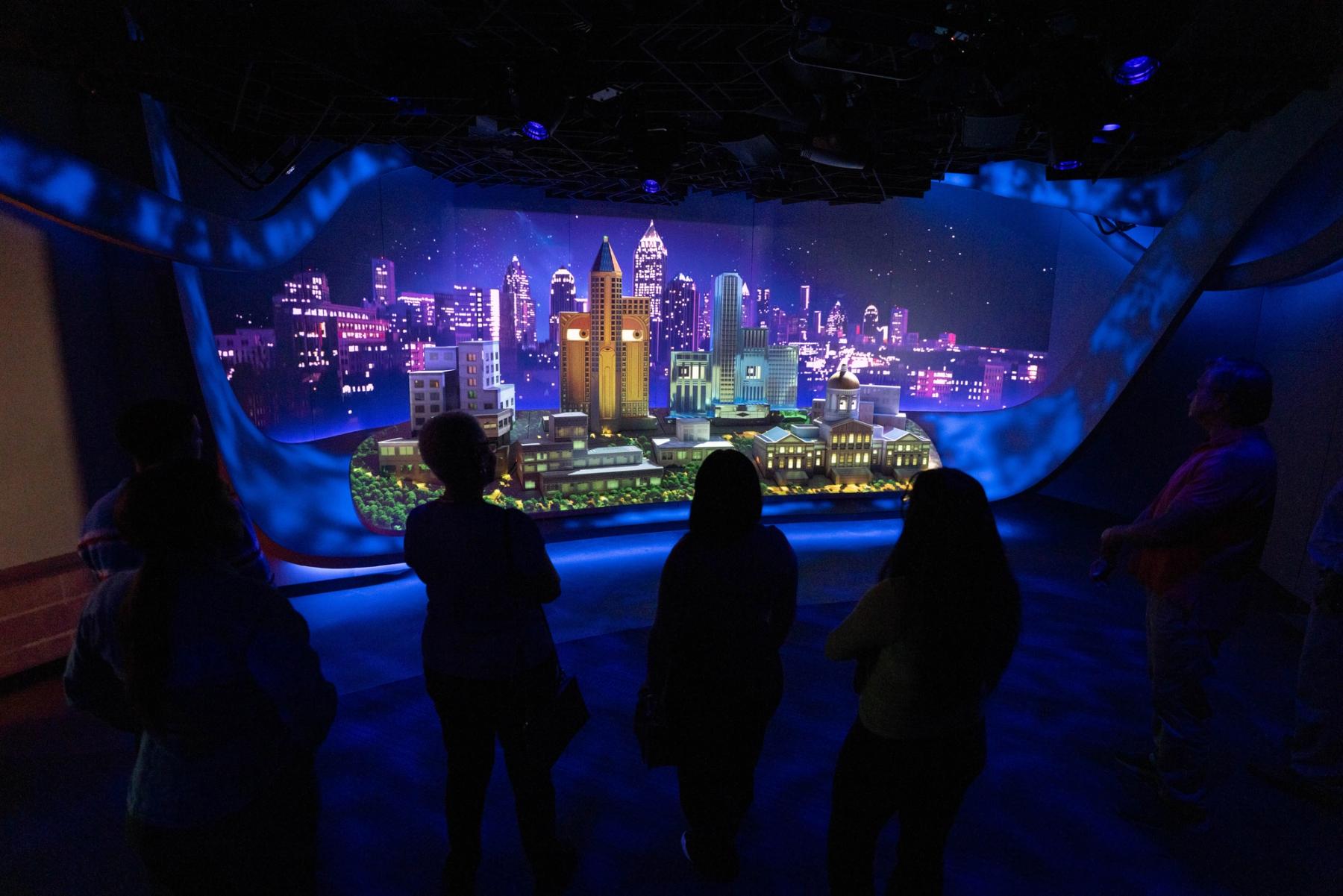
A key moment brings this to life: an animated Paula appears to leap from art frame to art frame across the room. The playful “break-free” concept guides attention effortlessly from display to display, while also shaping the flow of visitors through the space.
Making an unbounded experience like this possible required unusually close collaboration across disciplines. In the words of Matthew Solari, VP, Creative & Story at BRC, the project’s awards recognition from Muse, Brand Impact, Drum, and Hollywood Music in Media is a testament to “not only the creativity of the concept but also the incredible collaboration and craftsmanship that brought SCADstory Atlanta to life.”
Step by Step
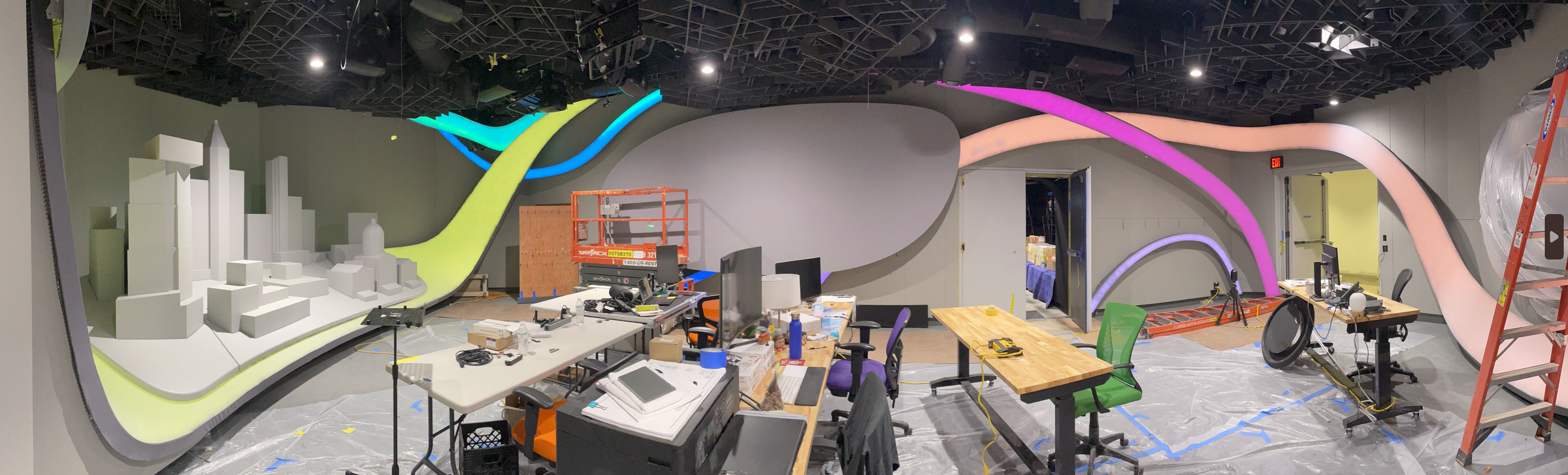
dandelion + burdock was tasked with unifying the media screens and projection zones through a coherent set of design templates for the creative teams. We also integrated all LED strip lighting in the venue, enabling Lighting Designer Manny Treeson to plan and control pixels comprehensively as virtual fixtures.
The most challenging element was a set of eight ribbons weaving through the main room. Their organic paths, constantly changing curvature, and varying width make them sculptural objects in their own right.
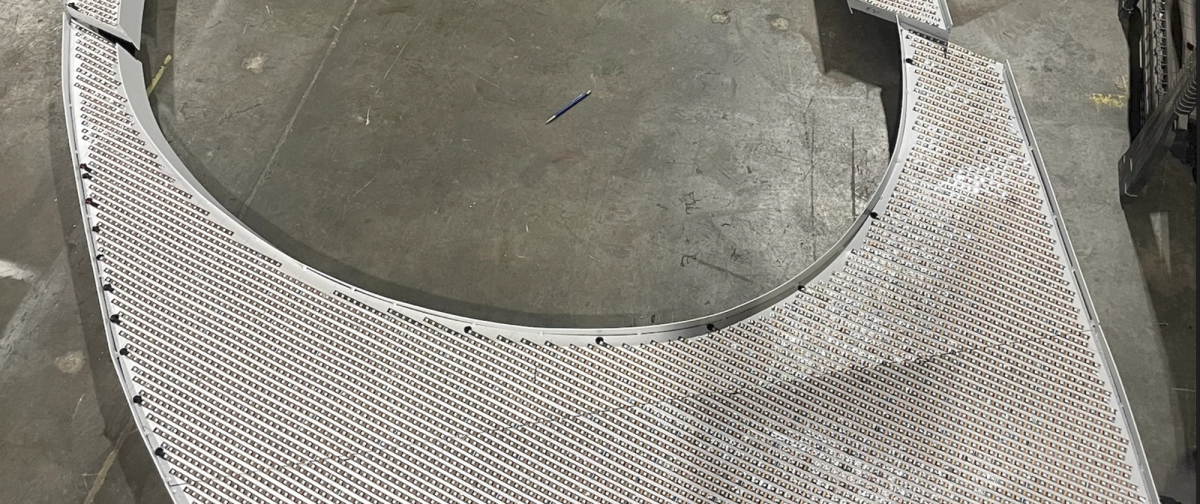
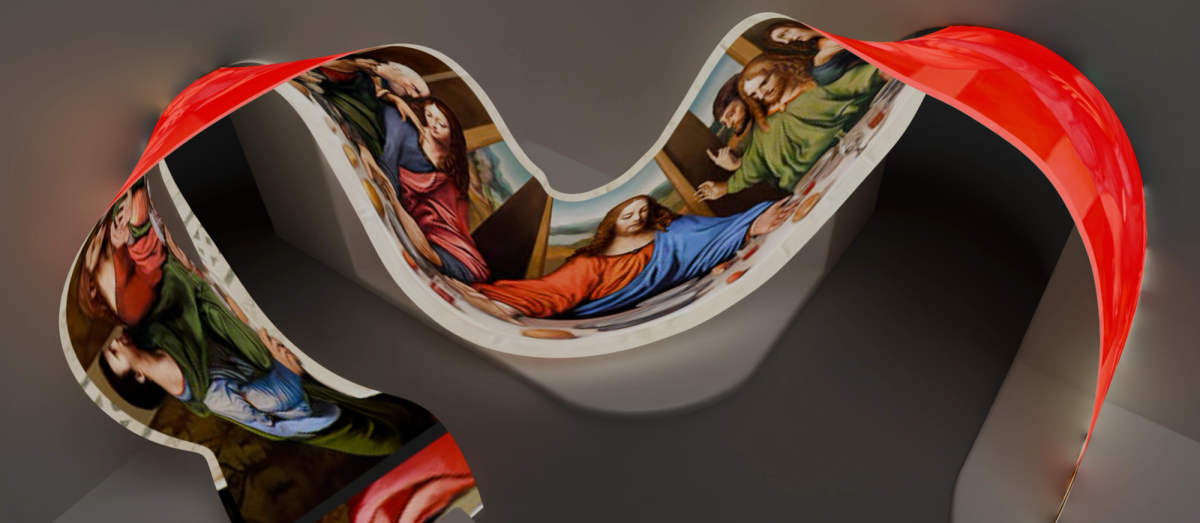
Because of this complexity, the ribbons had to be hand-fitted with LED pixel strings, carefully meandering across each surface for consistent visual distribution and practical technical access. While the LED schematics and DMX addressing were still evolving, we created proxy models that captured the ribbons’ final forms. Each proxy was a simplified band following the primary curvature of its ribbon and treated as a continuous surface. These proxy surfaces were far easier to unwrap and texture, so we added masks to the UV layouts and used the proxies as the foundation for design and previs.
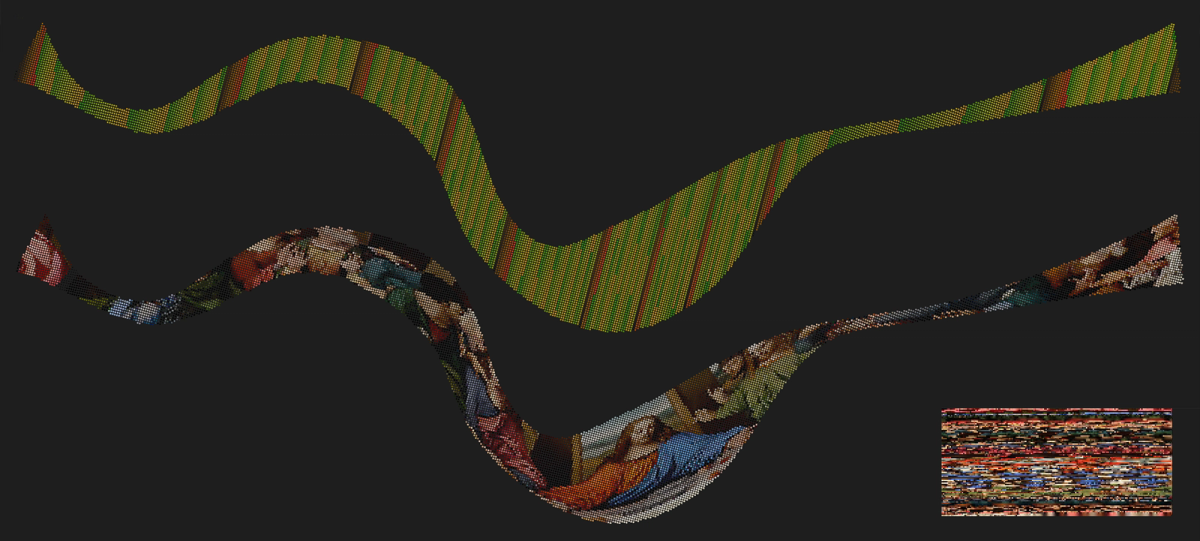
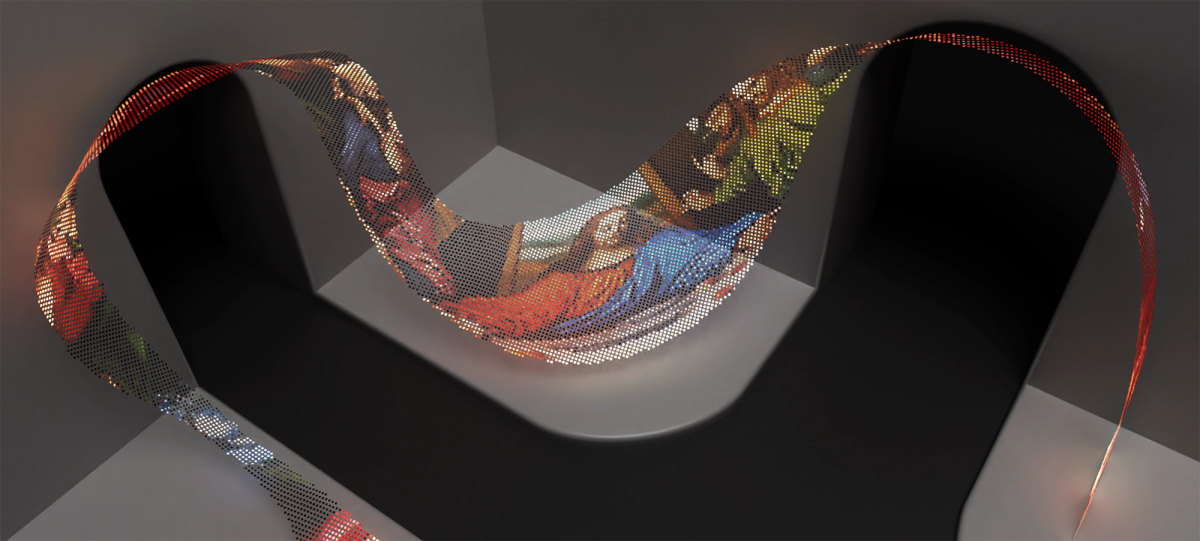
This approach allowed us to issue the creative template and begin developing real-time effects before the final position of every pixel in the room was known.
The SCAD Story experience was installed inside an occupied building, which introduced major construction constraints. For example, all deliveries into the main room had to pass through a limited aperture, so the ribbons were fabricated and delivered in parts, then assembled on site. In practice, that meant pixel seams and layouts could not be fully finalized until installation. To keep engineering and creative development moving in parallel, we maintained accurate pixel translations throughout manufacture and on site, updating outputs without stalling the creative pipeline.
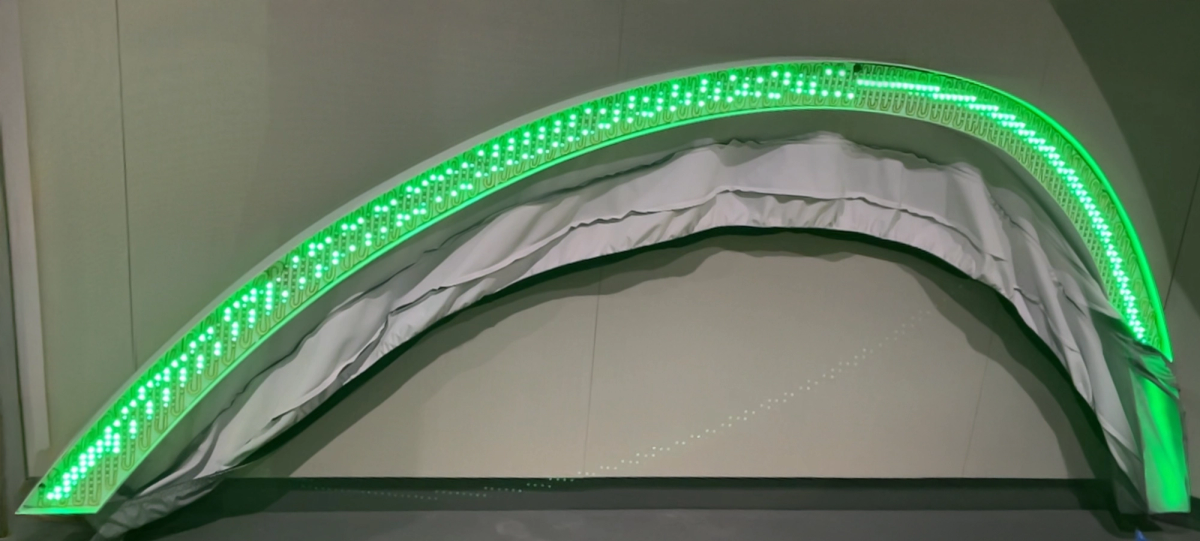
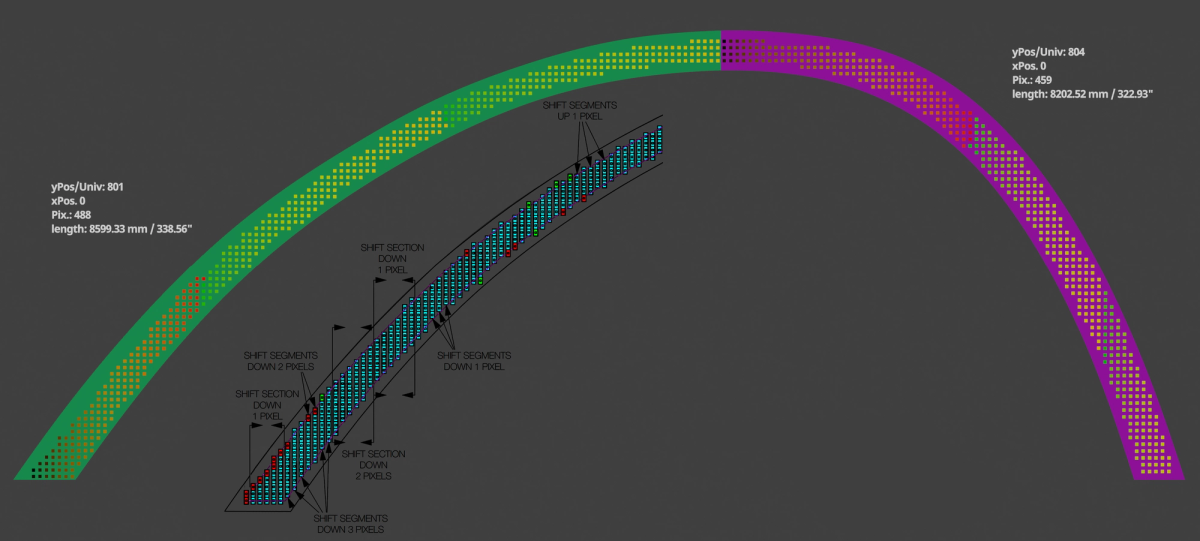
To support this, we built a procedural tool that projected flat electrical layouts onto the addressed, dimensional ribbon geometry via unwrapped polygons. Engineering changes were communicated through schematic drawings, augmented with clear instructions for shifts, deletions, and additions of LEDs. Those updates then drove our mesh revisions. Early on, updates for larger ribbons could take a few hours. Over time, and especially on site, the workflow improved to around 10–15 minutes, even when handling several hundred DMX universes, without demanding creative downtime.
The SCAD showspace reveals a unique scenario: a screen-based system, driven by real-time rendering in a Notch application, uses video tools but is creatively informed and controlled by the lighting department. On one hand, this is a natural fit because both the input variables and pixel outputs are DMX-based. On the other, it’s striking to see how lighting design, abstract in origin, unifies Paula’s story across many screens with such clarity and beauty.