
Over the past few years, artificial intelligence has moved from peripheral curiosity to active participation in our workflow. For a small creative studio operating in commercial design and motion, that shift has been practical rather than theoretical. It has affected how we prototype, how we solve problems and increasingly how we think about authorship and value.
We are a relatively lean team. We do not rely on extensive infrastructure or large internal departments. Efficiency and adaptability are structural necessities. When AI tools began demonstrating the ability to produce high-quality results with relatively low overhead, they were difficult to ignore. The interest was not driven by fear or by a single urgent problem to solve. It was more a recognition that this technology was developing rapidly and that remaining informed was part of responsible practice.
Early Technical Adoption
Our first meaningful engagement with AI was not creative but technical. Large language models became useful in navigating complex production software such as Houdini and Unreal Engine. Anyone who has worked deeply in those environments knows how specific and opaque certain technical problems can be. Historically, solving them involved searching through fragmented documentation and forum posts, hoping to find someone who had encountered the same issue.
Early LLMs were imperfect. They hallucinated, lacked access to up-to-date information and required constant verification. However, they introduced a new mode of structured reasoning. Even when the output was inaccurate, the procedural logic often had coherence. That alone accelerated troubleshooting. Instead of trawling the internet for partial answers, it became possible to iterate through a structured thought process and refine it manually.
There were limitations. Context could be lost. Conversations would reset. The illusion of continuity would break. But the potential was obvious. The model of interaction felt materially different from traditional search or documentation. It suggested that knowledge work itself was shifting.




First Creative Experiments
Creative experimentation followed, initially through image generation tools such as early versions of DALL·E and Midjourney. At that stage the outputs were limited in resolution and control, and they did not integrate seamlessly into production pipelines. The appeal was not refinement but speed.
For a small studio, the ability to generate visual stimuli quickly has practical value. AI became a way of exploring mood, tone and direction before committing to more resource-intensive workflows. It was particularly effective at breaking the inertia of a blank page.
There was also a broader sense of fascination. Interacting with a system that could interpret language visually felt novel. I approached it with curiosity rather than hostility. The ethical and environmental concerns surrounding AI are real and should not be dismissed, but from a purely process-oriented perspective the creative implications were significant.
The Shift in What We Value
The more consequential inflection point came with generative video models. Even in their imperfect early stages, it became apparent that long-standing assumptions about technical craft were likely to be challenged.
In visual effects and motion design, technical mastery has historically been central to differentiation. Complex simulations, rendering pipelines and compositing workflows require years of expertise. They also justify budgets and team sizes. However, difficulty does not automatically confer enduring value.
If a production requires an establishing shot that communicates a narrative beat, and that shot can be generated convincingly for a fraction of the previous cost, economic pressure will favour the more efficient option. Audiences do not evaluate scenes based on how technically difficult they were to produce. They respond to clarity, coherence and emotional impact.
For those of us working in technical roles, this is an uncomfortable realisation. Many of the processes we have spent years mastering are valuable largely because they have been the only available route to certain outcomes. As alternative routes emerge, the hierarchy shifts.
AI does not need to be flawless to be disruptive. It needs only to be sufficient.
This raises a more difficult question: if high-end visual style becomes widely accessible, how do we assess quality?
Beyond Replacement
We have yet to see a defining example of AI functioning as a genuinely new medium. Most applications remain variations on established forms. Images are rendered differently. Videos are generated through new pipelines. But the underlying grammar is familiar.
The moment of real significance will not be when a complex shot becomes cheaper. It will be when a piece of work emerges that could not have existed without this technology.
That distinction matters. Substitution alters cost structures. New forms alter culture.



Control, Authorship and Workflow Evolution
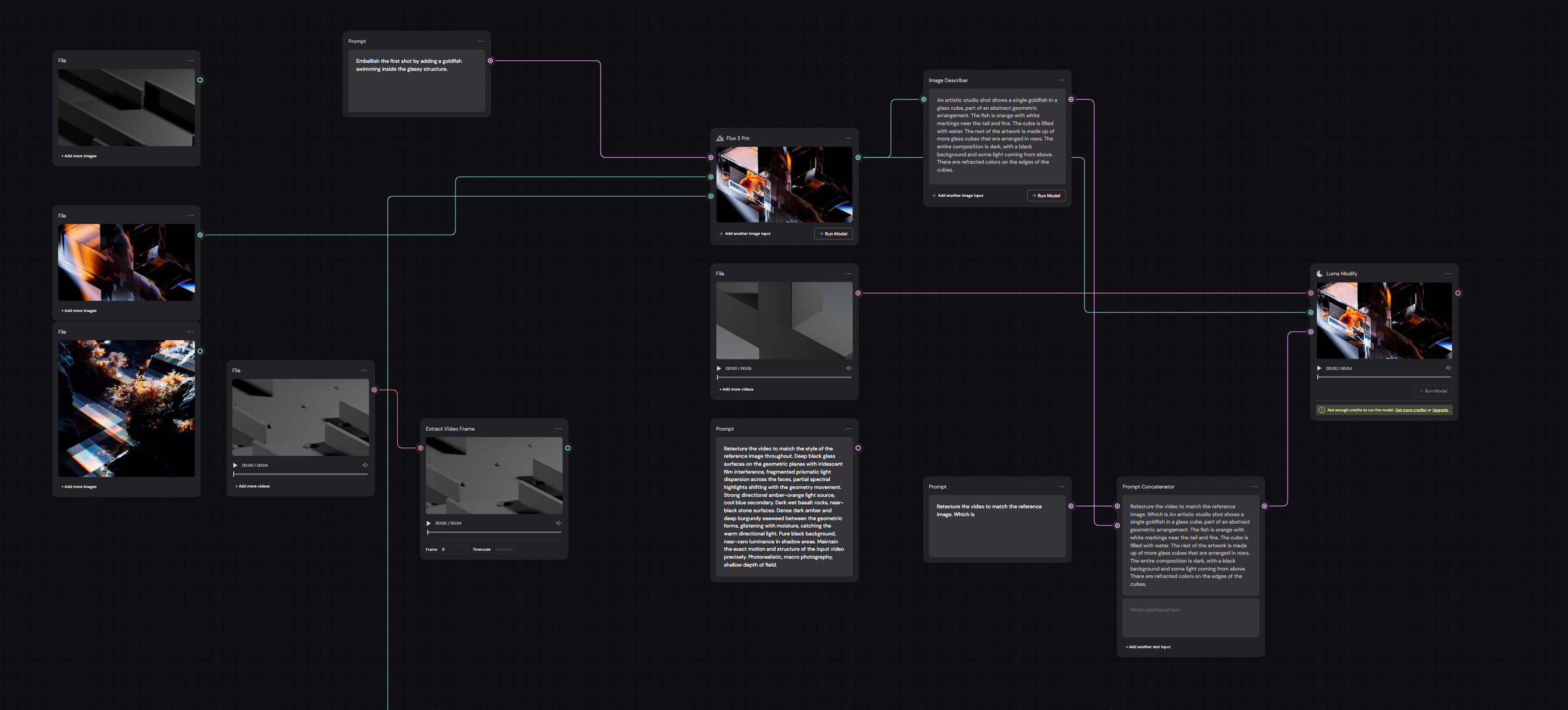
My initial instinct was not to rely solely on prompt-based systems. I value control and prefer to understand how tools function at a granular level. That led to experimentation within ComfyUI, building custom workflows and training LoRAs on internally produced renders and style frames. The goal was to embed our own visual language into the generative process rather than relying on generic model aesthetics.
This phase was important. Training models on our own datasets allowed for a degree of authorship. Lighting approaches, material choices and tonal preferences could be encoded into the system. It felt less like outsourcing and more like extending our existing practice.
However, the overhead was substantial. Significant time was spent managing infrastructure rather than producing work. Locally rendered experimentation is slow, and generative workflows require high iteration velocity.
Over time, we shifted towards tools that balanced flexibility with efficiency. Cloud-based systems such as Weavy.ai allowed for customisation without excessive setup, while Midjourney proved useful for rapid ideation, particularly when combined with our own rendered imagery as stylistic reference rather than defaulting to its identifiable aesthetic.
A key challenge became differentiation. When many practitioners have access to the same foundational models, visual homogeneity is a real risk. The task is no longer to produce impressive images in isolation, but to ensure that outputs remain grounded in a specific identity and intent.
Rethinking Quality
In commercial design and motion, quality has often been associated with polish, technical sophistication and production value. These characteristics remain relevant, but they are no longer scarce. As generative systems lower the barrier to entry, aesthetic surface becomes easier to achieve.
This shifts emphasis towards clarity of idea and strength of intention. Rather than beginning with visual ambition alone, projects increasingly require a clearly articulated purpose. What is being communicated? Why does it exist? Who is it for? These questions have always mattered, but they may now carry greater weight.
This does not imply that every piece must be narratively dense or conceptually heavy. It does mean that visual output detached from intent risks becoming interchangeable. When style is easily replicated, substance becomes the distinguishing factor.
At present, much AI usage in creative industries remains substitutional. It replaces concept art, previs, certain visual effects tasks and elements of writing. It approximates what already exists more quickly and at lower cost. That is economically significant, but it is not inherently transformative.
The more interesting question is whether AI can enable forms of work that were previously impossible rather than simply compressing existing workflows.




Human Value in a Shifting Landscape
It is tempting to assert that certain human qualities are irreplaceable: judgment, taste, emotional intelligence. It is possible that these will remain central, but even here caution is warranted. Many professional roles turn out to be pattern-based when examined closely, and pattern reproduction is precisely what these systems excel at.
What may endure is not execution but direction. Generative systems expand the field of possible outputs dramatically. Humans define the constraints. We decide which directions are worth pursuing and which are not. We frame objectives and evaluate outcomes against them.
In that sense, the role may shift from craft execution towards creative authorship and critical judgment. The capacity to articulate intent, impose structure and maintain coherence across rapidly generated possibilities may become more valuable than the ability to execute every element manually.
Where This Leads
The central question is no longer whether AI can replicate aspects of what we do. It can, and its capabilities will continue to expand.
The more meaningful question is whether we use it primarily to reduce costs and compress timelines, or whether it becomes a tool for developing genuinely new forms of creative expression.
If it remains a cost-reduction mechanism, the result will likely be consolidation and displacement. If it evolves into a medium, it may open new creative territories.
At present, we are still in an exploratory phase. Much of the work involves understanding limitations, identifying appropriate applications and resisting both uncritical adoption and reflexive rejection.
Quality, in this context, is no longer guaranteed by technical difficulty. It will increasingly be defined by clarity of intent, strength of concept and the ability to use these tools deliberately rather than reactively.
That is the recalibration currently underway.


